


What does political manipulation look like in Estonia?

becid
05.11.2025
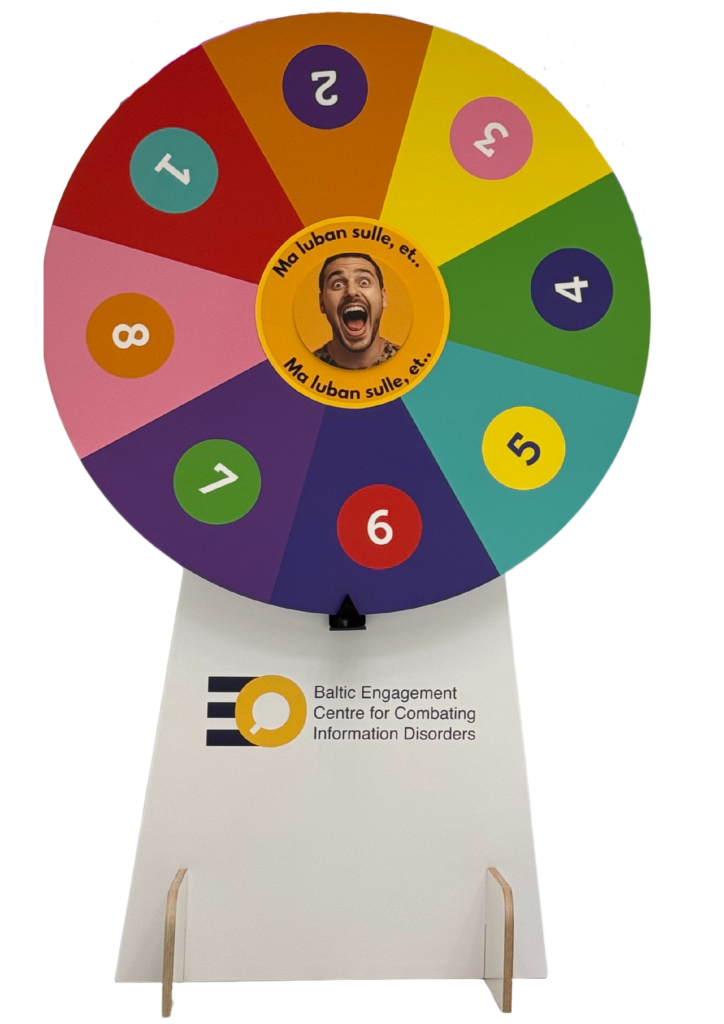
BECID invited voters to explore that question through our Propawheel installation – a media literacy tool that highlights 8 common manipulation techniques used in political communication.
Visitors could spin the wheel and draw a technique – such as labeling, fear-mongering, personal attacks, or “us vs them” framing. In addition, they could nominate a politician who they perceive uses manipulative messaging and describe which techniques they have noticed.
Propawheel Locations This Year:
- Sept 30 – Oct 30: University of Tartu Library
- Currently: University of Tartu Lossi 36 building
- From December: AHHAA Science Centre, Tartu
What did participants observe?
Total submissions: 38
A clear trend emerged:
– Most nominations pointed toward politicians representing conservative viewpoints.
This aligns with wider research showing that emotionally charged and polarising messages often gain high engagement during campaign periods.
Most frequently nominated figures (according to participants):
Sandra Laur – 11 submissions
Participants described a pattern of:
- Hostile labeling of minority groups;
- “Us vs them” framing;
- Emotional fear appeals;
- Personal attacks and demeaning stereotypes.
Several noted that she rose to prominence very suddenly, just before the elections — amplifying provocative rhetoric online.
Urmas Reinsalu – 5 submissions
Submissions pointed to:
- Populist blame narratives (“others are guilty of everything”);
- National security framing;
- Claims appealing to collective threat.
Martin Helme — 5 submissions
Common themes included:
- Catastrophising and crisis narrative;
- Demonisation of political opponents;
- Statements perceived as misleading or exaggerated.
Other names (1–3 mentions each) included public figures across the political spectrum – typically linked to:
- Populism;
- Selective presentation of facts;
- Attempts to appear as “one of the people”;
- Aggressive or dismissive communication styles.
What do these findings tell us?
- Respondents are especially alert to communication that divides society into “good us” vs “evil them”;
- Fear and identity-based messaging is recognised as highly manipulative;
- Social media visibility strongly shapes voter perception of manipulation;
- Even new political actors can quickly gain notoriety when using provocative styles.
Although this was not a scientific survey, it provides valuable insight into how Estonian voters experience political pressure and persuasion.
Why does this matter?
When people can identify manipulation techniques, they are:
- less vulnerable to distraction and emotional influence;
- more able to focus on real policy issues;
- better equipped to sustain a healthy democratic debate.
Thank you to everyone who participated – your insights help us understand how political messages shape our everyday decisions!